

How Section I Comprehending Works
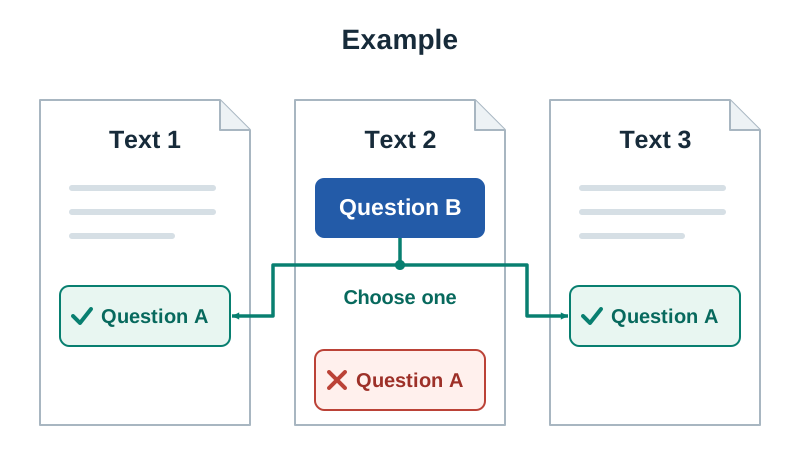
Section I tests how clearly you read, interpret, and evaluate unseen texts. The exam paper gives you three texts: Text 1, Text 2, and Text 3. The golden rule of Section I is simple but vital: you must answer Question A on one text and Question B on a completely different text. If you answer Question A and Question B on the exact same text, you run the risk of losing the marks for one of those 50-mark answers entirely. Read through the paper and make your choices before putting pen to paper.
Your work across Leaving Certificate English is marked using four assessment criteria known as the PCLM system:
- Clarity of Purpose (P): Directly answering the question asked, keeping your focus tight, and showing a solid grasp of the chosen genre.
- Coherence of Delivery (C): Structuring your ideas logically with clean paragraph breaks, sensible progression, and linking phrases.
- Efficiency of Language Use (L): Writing with precision, vocabulary control, varied sentence shapes, and an analytical tone that cuts out waffle.
- Accuracy of Mechanics (M): Handling spelling, grammar, syntax, and punctuation cleanly.
Question A is worth 50 marks and breaks down into three distinct tasks: Question (i) carries 15 marks, Question (ii) carries 15 marks, and Question (iii) carries 20 marks. Keep an eye on the clock during the exam. Spend roughly 45 to 50 minutes on Question A, making sure you leave at least 20 to 25 minutes for part (iii) so that you can examine all four required elements in depth.
Answering 15-Mark Questions: Insights and Personal Response
Questions (i) and (ii) each carry 15 marks. The most dependable approach is to develop three distinct, well-supported points across three separate paragraphs, using the Point, Quote, and Explain structure.
Question (i)
Question (i) tests direct comprehension. Typical prompts ask you to explain three distinct insights or discuss what the passage reveals about a person, place, or issue. Every point you offer must be genuinely separate from the others. If you repeat the same point in different vocabulary, you lose marks under Clarity of Purpose. A quick check is to ask yourself whether each paragraph's opening topic sentence could stand on its own as a distinct answer.
When a prompt instructs you to respond in your own words, you cannot simply copy out chunks of the passage. Paraphrase the writer's thought first using your own vocabulary, then anchor it with a short quotation of two or three words. For instance, if an author writes that an anxious character felt 'smaller and smaller' in a room of strangers, do not reproduce that full sentence as your point. Write: 'Ray feels completely diminished in social settings, as shown when he notes that he shrinks "smaller and smaller" among strangers.' The thought belongs to you, and the quoted phrase serves purely as direct evidence.
Question (ii)
Question (ii) shifts from year to year. It often asks for your personal response to an idea, argument, or human situation raised in the text. Always read the question carefully. You might be asked whether you find a writer's viewpoint convincing, how an observation relates to the world around you, or what lessons emerge from the piece. Ground every reflection in specific details from the passage. Offer thoughtful, mature reactions rather than superficial praise or dismissal.
The 20-Mark Stylistic Analysis: Taking a Stance on Four Elements
Question (iii) evaluates style: how an author writes rather than merely what happens. Higher Level papers routinely ask you to 'Identify four elements of the writer's style' or ask 'To what extent do you agree...?' with direct reference to four elements.
Reading the Question Verbs
- Explain: Clarify how a specific mechanism or idea works.
- Outline: Summarise key points logically without retelling plot events.
- In your own words: Translate the passage's meaning into your own language, using brief quotes only to back up your claim.
- Discuss: Explore ideas thoroughly, showing how techniques function in their immediate context.
- To what extent do you agree: Form an evaluative judgement, declare your stance in the opening line, and sustain that viewpoint throughout.
- How effectively: Weigh up how successfully the writer achieves a particular goal, acknowledging strengths and potential shortcomings.
Elements of Style You Can Name
- Tone: for example reflective, urgent, or humorous.
- Word choice (diction): evocative verbs, emotive adjectives, or stark nouns.
- Sentence structure: short, blunt sentences speed up the pace or create drama; long, flowing sentences slow the reader and build detail.
- Imagery and figurative language: similes, metaphors, and sensory description.
- Sound patterns: alliteration, assonance, or rhythm.
- Personal voice: an intimate or authentic first-person perspective.
- Anecdote: a brief personal story used to illustrate a point.
- Structure: deliberate choices in how a text opens, contrasts ideas, or concludes.
Formulating Your Stance
When a prompt asks 'To what extent do you agree?' or asks if a passage is effective, declare your stance in your very first sentence. You can agree wholeheartedly, agree with clear reservations, or offer a measured critique. Write about exactly the number of elements the question asks for, usually four at Higher Level, one paragraph each. If no number is given, four well-developed elements is a safe target. Finish each paragraph by linking that feature back to the adjectives in the prompt, such as 'thought-provoking' or 'disturbing'. If the prompt pairs two qualities, such as 'both informative and thought-provoking', you must address both qualities across your response.
Steer clear of lazy comments like 'this grabs the reader's attention' or 'it creates a vivid picture in my head'. Instead, use active analytical verbs that pinpoint exact effects: evokes, illustrates, highlights, contrasts, suggests, and crystallises.
The Five Functions of Language
The Leaving Certificate syllabus classifies language into five general categories based on purpose. In practice, genuine writing blends these modes. An investigative article might lean on narrative anecdotes and persuasive appeals to explain technical data. Your job is to identify which function is dominant and show how secondary functions support it.
| Function | Dominant Purpose | Core Features and Syllabus Reading Skills |
|---|---|---|
| Language of information | To educate, clarify, and present facts without overt bias. | Facts, figures, expert testimony, and clear structure. Informative pieces are rarely completely detached. Check the selection of facts, notice what gets left out, and identify the author's underlying point of view. |
| Language of argument | To convince through logical structure and evidence. | Tracing claims through to conclusions; using connective words (therefore, because, nevertheless); separating opinion and anecdote from verifiable evidence; questioning hidden assumptions; and checking logical validity. |
| Language of persuasion | To shape attitudes, stir feelings, or urge action. | Deliberate tone, vivid imagery, rhythmic phrasing, selective detail, rhetorical questions, direct address, and emotive diction. Ask yourself who the intended audience is, what values are promoted, and whose interests the piece serves. |
| Language of narration | To tell a story, trace events, or capture human character. | Narrative voice (first person, third person omniscient, or child perspective); striking openings; characterisation via dialogue and actions; setting; shifts in atmosphere; and narrative pace. |
| The aesthetic use of language | To create artistic pleasure and explore experience through craft. | Rich sensory description, fresh metaphors, musical sound patterns (alliteration, assonance), cadence, and symbolic resonance. |
Reading Multi-Modal and Visual Texts
Comprehension texts sometimes feature visual elements, including book jackets, magazine layouts, advertisements, or photo essays. The syllabus treats verbal and visual communication as intertwined systems that work together to shape meaning.
When you analyse visual media, avoid vague personal reactions. Connect specific design choices directly to the creator's communicative purpose:
- Layout and composition: Look at how elements are placed on the page. A dominant central image grabs immediate attention, while foreground and background arrangements establish scale or power relationships between subjects.
- Typography: Font style and weight convey tone instantly. Thick, sans-serif block lettering suggests urgency, strength, or modern authority; traditional serif lettering suggests heritage, formal authority, or quiet literary reflection.
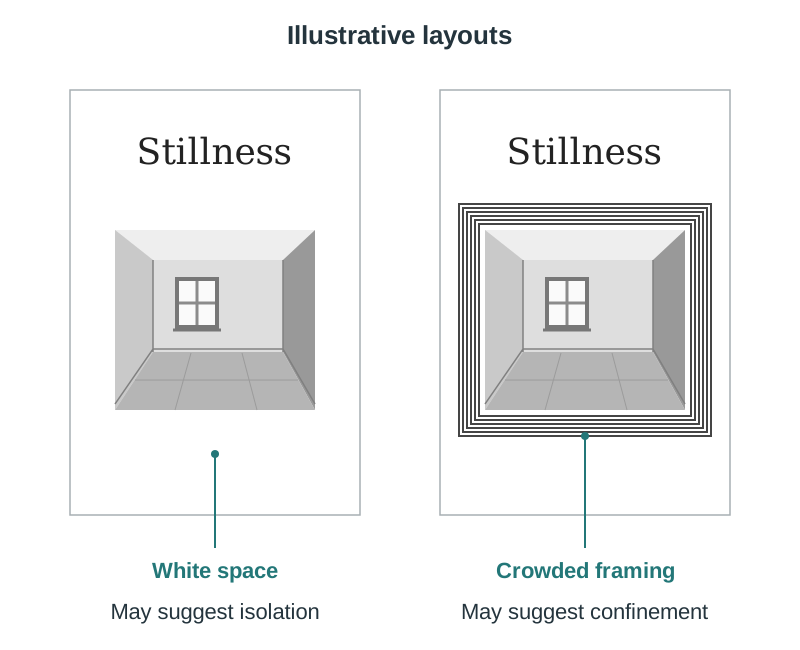
- Colour and contrast: Interpret colours within their actual context rather than applying rigid symbolic formulas. A stark black-and-white image of a deserted room removes warmth, emphasising stillness, decay, or isolation.
- White space: Deliberate empty space around an image or paragraph focuses the eye, suggests elegance, and improves readability, whereas cramped space creates a sense of frantic energy or claustrophobia.
- Text-image relationship: Examine how headlines or captions interact with images. A caption might clarify an ambiguous photograph, reinforce its emotional punch, or introduce deliberate irony.
The PCLM Assessment Criteria and the TAGS Framework
Examiners mark Question B and the composition under four headings, known as PCLM:
- Clarity of Purpose (30%): Direct engagement with every element of the task, mastery of the chosen genre conventions, and sustained awareness of the intended audience (15 marks in Question B; 30 marks in Section II).
- Coherence of Delivery (30%): Logical organisation, clear transitions between paragraphs, and sustained focus from opening to close (15 marks in Question B; 30 marks in Section II).
- Efficiency of Language Use (30%): Control of register, vocabulary, sentence structure, and rhetorical techniques matched to the medium and reader (15 marks in Question B; 30 marks in Section II).
- Accuracy of Mechanics (10%): Precision in spelling, grammar, syntax, and punctuation (5 marks in Question B; 10 marks in Section II).
Allow roughly 40 minutes for Question B: spend 5 minutes reading and planning, 30 minutes writing, and 5 minutes proofreading. Most strong responses require roughly one and a half to two pages of handwriting to develop all compulsory elements thoroughly.
The TAGS Planning Method
Before writing, break down the prompt using TAGS:
- Topic: Identify the exact issue, debate, or situation. Underline every compulsory sub-task in the prompt so nothing is left out.
- Audience: Determine who will read the text. A local council, a company director, school peers, or followers on a social platform each expect different language.
- Genre: Establish the physical and structural layout immediately. A formal letter requires addresses and formal sign-offs; an investigative report demands headings and bulleted findings; an open letter needs a broad address and an engaging opening.
- Style: Decide whether the task calls for the language of information, argument, or persuasion. Match the register to the publication context. Formal administrative documents need measured, objective phrasing, while pieces published on online platforms or addressing general audiences can be warmer, personal, or even humorous when the question permits. Whatever tone you choose, keep it consistent and controlled throughout.
Formal Letters: Layout, Applications, and Complaints
A formal letter communicates clear, structured, and respectful information or requests to a specific individual, institution, or commercial body.
Visual Layout of a Formal Letter
                                                    Sender's Street Address
                                                    Town / Locality
                                                    County / Eircode
                                                    Date (e.g. 14 October 2026)

Recipient's Name (if known)
Recipient's Job Title
Organisation Name
Office Address
Town / County

Dear [Title and Surname / Sir or Madam],

Re: [Concise Statement of Subject / Reference Number]

[Opening paragraph: state the direct purpose of the letter immediately.]

[Body paragraph 1: background details and evidence.]

[Body paragraph 2: impacts and reasoned arguments.]

[Concluding paragraph: specific desired action and polite closing statement.]

Yours sincerely, / Yours faithfully,

[Signature]

[Printed Name]
Layout and Language Rules
- Sender's details: Positioned in the top right corner without your name above it. Place the date directly underneath.
- Recipient's details: Placed against the left margin below the date line. Include their name (if given), their job title, and the organisation's address.
- Salutation: Open with Dear Mr Connolly, or Dear Dr Walsh, when the recipient's name is known. Open with Dear Sir/Madam, when addressing an unnamed official.
- Reference line: Insert a concise subject line below the greeting (e.g. Re: Disruption to Route 44 Bus Services). This signals immediate Clarity of Purpose.
- Register and tone: Maintain a polite, reasoned tone. Avoid contractions (write 'do not' rather than 'don't'). State your purpose in the first paragraph, provide factual evidence in the body, and conclude with a specific call to action.
- Valediction: Always match the opening salutation to the sign-off:
- If you open with a person's name (Dear Ms Clarke,), close with Yours sincerely,.
- If you open without a name (Dear Sir/Madam,), close with Yours faithfully,.
- Never mix these forms.
Common Formal Letter Types
- Letter of application: State the advertised role and where you found it in your first sentence. In the body, align two or three of your strengths or achievements with the specific requirements of the position. State your availability for an interview and conclude with the appropriate valediction.
- Letter of complaint: Identify the fault, date, location, and relevant transaction numbers in the opening lines. Detail the disruption or loss factually without emotional exaggeration or aggressive language. Close by requesting a specific remedy, such as an inspection, replacement, or refund by a set date.
- Personal (informal) letter: By contrast, a personal letter places only the sender's address and date at the top right (no recipient address), uses an informal greeting (Dear Liam,), allows contractions and conversational register, and closes with a warm sign-off (All the best, or Warm regards,).
Public Correspondence: Letters to the Editor and Open Letters
Public correspondence is composed for broad readership across newspapers, journals, or digital platforms. The core conventions differ depending on the publication channel.
Letter to the Editor
A letter to the editor contributes to public debate in response to a recent news story, editorial column, or cultural development.
- Salutation: Open with a short greeting: Sir, or Madam,, Dear Editor,, or A Chara,.
- Headline (optional): Broadsheets create their own headlines, but providing a short title that captures your central stance clarifies your focus for the examiner.
- Opening line: Identify the specific article, author, or issue prompting your letter in the first sentence.
- Body: Present two or three compact, analytical points. Use balanced syntax, rhetorical questions, and sharp reasoning.
- Valediction: Use the standard broadsheet sign-off: Yours etc., followed by your name and locality (e.g. Ennis, Co. Clare). Neither the editor's postal address nor your full residential address is needed.
The Open Letter
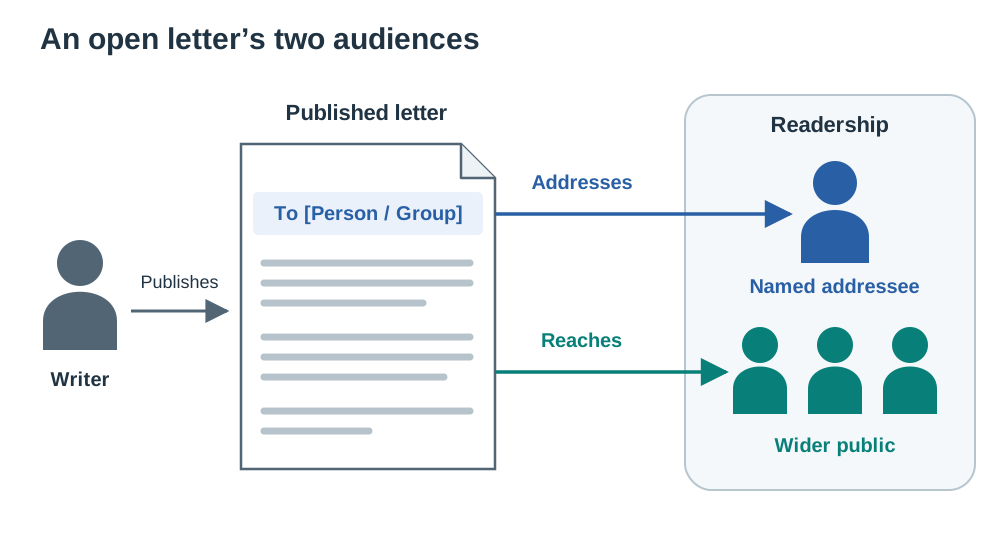
An open letter addresses a specific person, committee, or group (e.g. 'To the Minister for Education,' or 'To all those who offer unwanted advice'), but is published openly in print or online to inform, persuade, stimulate public debate, or entertain.
- Tone and platform: Register follows the medium and the prompt. An open letter published on a social platform should be engaging, direct, and conversational, speaking straight to the audience. If the question states the piece 'may be amusing or serious or both', a light, witty voice is fully rewarded provided it remains controlled and sustained.
- Anticipating and refuting opposition: Persuasive and argumentative prompts often require you to address alternative stances. Use a three-step refutation method:
- State the opposing view fairly ('Some will argue that...' / 'Critics might claim that...').
- Concede what is reasonable in it ('It is true that...').
- Rebut it with a reason, comparison, or evidence showing why your original conclusion still stands ('Yet...').
Comparing Letter Formats
| Feature | Standard Formal Letter | Letter to the Editor | Open Letter |
|---|---|---|---|
| Addresses | Both sender's (top right) and recipient's (left margin) | Sender's locality only; no recipient postal address | None; platform or publication medium identified |
| Salutation | Dear Mr Kelly, or Dear Sir/Madam, | Sir, / Madam, / Dear Editor, / A Chara, | To [Person / Group / Public], |
| Title | Optional Re: subject line | Optional stance headline | Recommended title setting out the theme |
| Valediction | Yours sincerely, or Yours faithfully, | Yours etc., | Courteous closing line, signature, and name |
Administrative Documents: Reports, Proposals, and Civic Petitions
Workplace and civic documents replace continuous narrative prose with visible layout: numbered headings, concise analytical paragraphs, and clear bullet points.
The Investigative Report
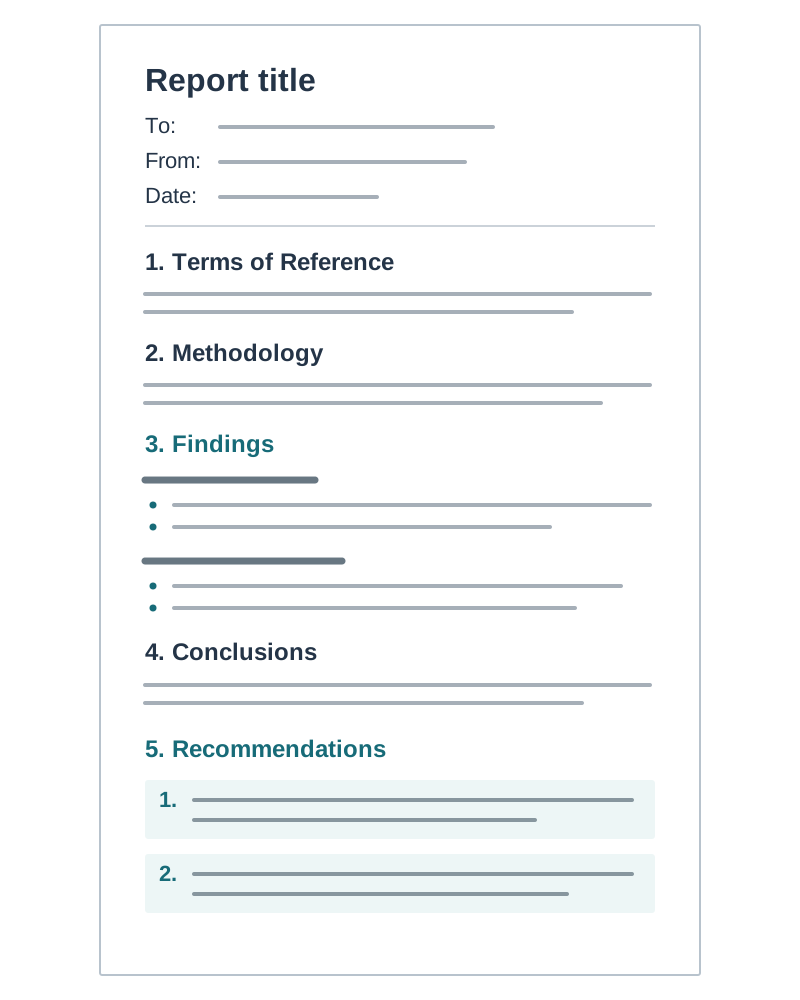
A report provides an objective, analytical record of an investigation, incident, or existing condition. It uses the language of information to present facts and evidence calmly.
| Section | Function | Example Phrasing |
|---|---|---|
| Header Block | Identifies the subject, recipient, author, and date | Report on Senior Cycle Study Facilities; To: Board of Management; From: Student Council Executive; Date: 18 November 2026 |
| 1. Terms of Reference | States who commissioned the report, its scope, and its purpose | Commissioned by Principal Murphy to investigate after-school study facilities and identify required equipment upgrades. |
| 2. Methodology | Explains precisely how evidence was gathered | Information was collected through an online questionnaire completed by 180 senior students and an interview with the school librarian. |
| 3. Findings | Presents the facts and figures you found, grouped under headings | 74% of surveyed students reported inadequate desk space; 68% noted a shortage of power outlets for learning devices. |
| 4. Conclusions | States what the findings show based on the evidence | Current library provisions are inadequate for self-directed study and hinder candidate exam preparation. |
| 5. Recommendations | Sets out numbered, practical actions arising from the conclusions | 1. Convert Room 14 into a quiet study annex. 2. Install ten double power sockets along the perimeter wall. |
The Formal Proposal
While a report investigates past or present realities, a proposal looks forward. It pitches a structured initiative to solve a problem and requests administrative backing or funding:
- Title and Aims: Define the project and state who is submitting the proposal.
- Problem Statement: Detail the current difficulty with plausible facts.
- Proposed Solution: Describe the recommended action and its practical advantages.
- Implementation Schedule: Outline realistic, phased milestones (Phase 1: Procurement; Phase 2: Rollout; Phase 3: Review).
- Conclusion: Conclude with a direct request for administrative approval.
The Civic Petition
A petition is a formal collective request, signed by many people, urging an authority to take a specific action. It must balance civic passion with respectful, measured phrasing:
- Addressee line: State the body that holds decision-making authority (To: The Chief Executive, Kildare County Council).
- Title: Express the core goal clearly (Petition to Establish a Dedicated Cycleway along the Mill Road).
- Opening declaration: Identify the collective community voice: 'We, the undersigned residents, commuters, and parents of the Mill Road community...'.
- Grounds for petition: Outline the issue across two or three numbered arguments, providing plausible local details and safety considerations.
- Call to action: Formulate an explicit, actionable demand ('We therefore call upon the Council to allocate funding under the active travel scheme and begin construction before September 2027').
- Signature block: Provide a short signatory call followed by sample signature columns (Name | Address / Locality | Signature).
The Core Assessment Framework: PCLM and Task Planning
Every composition in Leaving Certificate English is evaluated against four criteria established by the State Examinations Commission:
- Clarity of purpose (30%): Engaging directly with the prompt, adopting the correct register for the stated speaker and audience, and covering every bullet point or requirement in the task.
- Coherence of delivery (30%): Structuring the piece with logical transitions, sustained momentum, and a shape that feels complete, with a clear opening and a satisfying ending rather than one that just stops.
- Efficiency of language use (30%): Crafting vivid, precise, and expressive prose suited to the medium. Digital and broadcast tasks usually call for a spoken, engaging voice, informal for a personal blog or podcast and more measured for a serious radio talk. Always match the register to the audience named in the task.
- Accuracy of mechanics (10%): Maintaining standard spelling, punctuation, grammar, and sentence structure.
Covering Every Bullet Point
Question B tasks usually specify three things: who you are, who is listening or reading, and what you must do. Before writing, underline each prompt in the question and allocate it a paragraph or section in your plan. If a prompt asks for tactical advice, an opponent review, and a motivational closing, leaving out any one of those three limits your mark for clarity of purpose, which drags down the rest of your grade.
The Personal Diary: Introspection and Emotional Truth
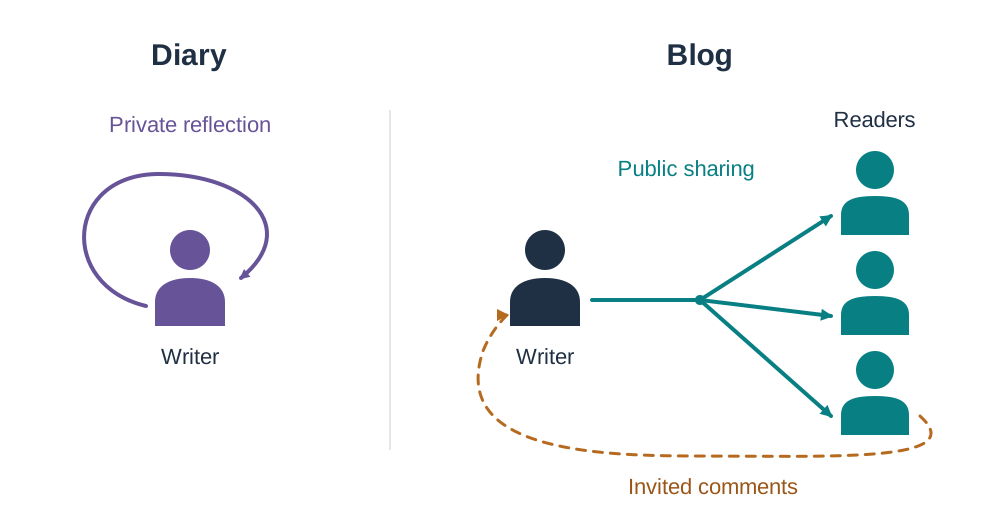
A diary entry is private writing meant solely for the writer, or an imagined persona. Because it is not written for an external public audience, its register relies on emotional vulnerability, interior monologue, and uninhibited candour.
Practical Diary Conventions
- Open with the date at the top of the page, for example Thursday, 14th November, and add the time or place if you wish, such as 11:15 pm, kitchen table. After that, move straight into the writer's thoughts.
- You can open with a greeting like Dear Diary or dive directly into your thoughts. Both approaches work well.
- Selective focus: Develop two or three important moments or changes in feeling instead of listing everything that happened that day.
- Avoid formal correspondence endings like Yours sincerely. Conclude on an unresolved question, a quiet realisation, or a thought about tomorrow.
- Exam questions sometimes ask you to write as a specific character or to compose a sequence of two or three entries. When writing a series, make sure each entry shows a clear change in thought, mood, or circumstance so the response develops rather than repeats itself.
Style and Interiority
Informality in a diary comes from psychological honesty, varied sentence rhythms, and sensory details, never from text-speak or lazy grammar. Use dashes and occasional ellipses to capture half-formed realisations.
The Blog Post: Public Digital Voice and Useful Conventions
A blog post bridges personal reflection and public discussion. It addresses an active online readership, balancing individual personality with ideas the audience can relate to.
Useful Blog Conventions
A short headline and one or two light touches are enough to signal the form. Purpose marks come from sustaining the right voice for the stated audience and dealing fully with every part of the task throughout the answer, not from elaborate layout.
- Provide a punchy headline that sets up the topic.
- You may include a brief web address banner, pseudonym, and date at the top, but do not waste time drawing complex page designs.
- Drop in a bracketed hyperlink reference, for example [read my earlier piece on morning routines here], to give the feel of online publishing.
- End with a call to action, such as a direct question inviting readers to share their views in the comments section.
Voice and Balance
A blog should not read like a formal academic essay. Write in the first person, address your readers directly using 'you' and 'we', and use humour or self-deprecation to make your points memorable.
The Radio Talk and Broadcast Interview: Spoken Register and Interaction
Radio scripts are written for the ear. They rely on verbal rhythm, clear sentence structures, and audible signposts so listeners can follow spoken ideas without needing to reread.
The Single-Speaker Radio Talk
Open with a brief greeting that introduces who you are, the programme name, and your topic. Use verbal signposts such as 'My second point is simple' or 'Let me take you back three years' to mark out stages in your talk. Sentences should sound natural when read out loud, mixing short emphatic statements with longer explanatory ones.
The Two-Speaker Broadcast Interview
Set the broadcast context briefly with bracketed sound cues if needed, such as [theme music fades]. Identify speakers clearly on each new line using speaker tags.
| Speaker | Typical Role & Register | Balance of Talk |
|---|---|---|
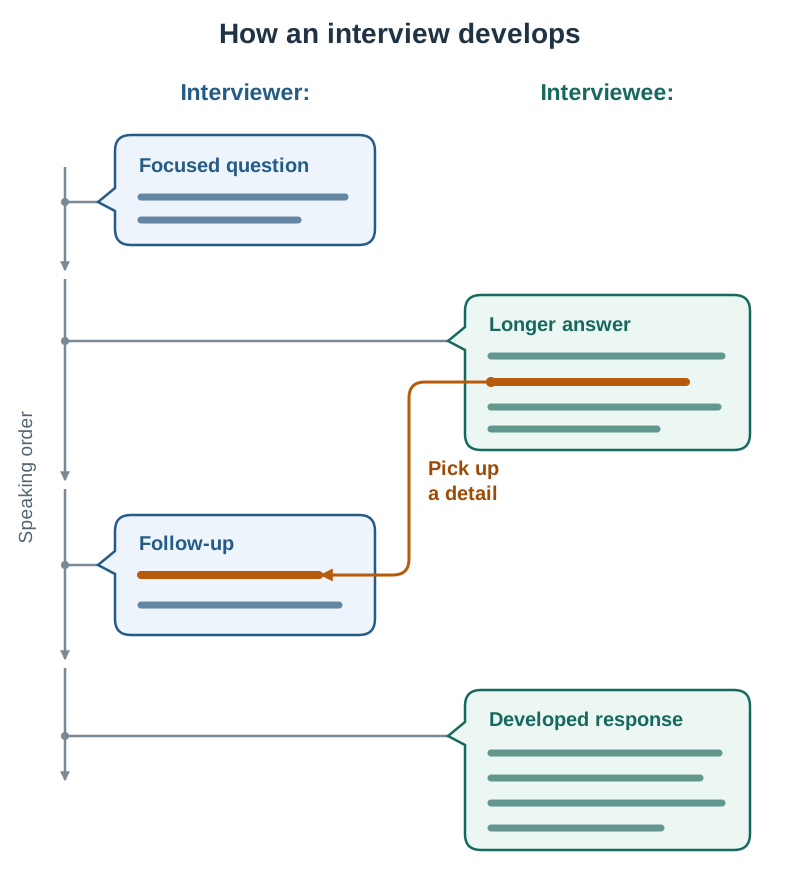
| Interviewer | Guides the discussion, listens actively, sets context, and follows up | Keeps questions focused and purposeful; questions can be one or two sentences, with longer turns to challenge or set context |
| Interviewee | Provides personal stories, expert insights, and reflective depth | Does most of the talking; uses developed paragraphs with anecdotes and personal opinion |
The host must react naturally to what the guest just said before moving to the next question. Avoid turning the script into a mechanical question-and-answer list.
The Podcast Script: Intimate Conversational Storytelling
Podcasts often feel more personal than radio: the listener chooses the show and usually hears it alone on earphones, so the host can talk as if to one friend.
Podcast Framework
- The Hook and Welcome: Greet your listeners, name the show, and draw them in with a curious question or a relatable, mildly chaotic dilemma.
- The Conversational Core: Work through two or three focused segments. Move between personal stories, cultural references, and thoughtful reflections using smooth bridges like 'That brings me to the strangest part of this whole business...'.
- The Outro: Pull your thoughts together, leave listeners with a memorable idea, invite them to subscribe or leave a comment, and close with a consistent sign-off phrase.
The techniques taught for blogs and talks, such as anecdote, direct address, humour and rhetorical questions, work in podcasts too. Choose the mix that suits your audience, and keep a natural spoken rhythm.
Reading Personal Media Writing: Question A Stylistic Features
The techniques you practise when composing personal media are the exact features Question A asks you to identify and evaluate in Comprehending texts. Past exams frequently ask students to discuss four stylistic features that make a personal essay, memoir extract, or media article engaging.
Key Stylistic Features to Identify
- Authentic personal voice: The writer establishes an unmistakable, credible personality from the outset.
- Anecdote: A short, concrete personal story used to illuminate a wider truth.
- Tonal variety: Shifting between humorous, reflective, confessional, and earnest registers.
- Self-characterisation: The writer depicts themselves as a distinct, sometimes flawed or humorous character.
- Vivid imagery: Fresh similes, metaphors, and sensory details that make experiences tangible.
- Varied sentence length: Short, punchy sentences for dramatic emphasis set against longer, reflective sentences.
- Direct address and inclusive language: Using 'you' and 'we' to build rapport with the reader.
Why Personal Writing Appeals
When asked to explain the enduring appeal of personal writing such as memoirs and diaries, build your answer around three distinct points:
- The first-person voice creates an immediate human connection, allowing readers to share another person's private thoughts.
- True-life stories offer realistic grounding that appeals to readers who prefer non-fiction over invented plots.
- Insider accounts satisfy natural curiosity about worlds, eras, or professions readers could not otherwise experience.
Key terms
- PCLM Criteria
- The four marking criteria used across Leaving Certificate English: Clarity of Purpose (P), Coherence of Delivery (C), Efficiency of Language Use (L), and Accuracy of Mechanics (M).
- Insight
- A perceptive, inferential observation drawn from a close reading of a text, digging beneath surface summary to reveal underlying feelings, values, or character traits.
- In Your Own Words
- An examination directive requiring candidates to express ideas using their own vocabulary, keeping quotations short and using them strictly as supporting evidence.
- Stance
- A decisive, clear point of view adopted by a candidate when answering an evaluative prompt (such as 'To what extent do you agree?'), sustained throughout the entire response.
- Opinion vs Anecdote vs Evidence
- Three different kinds of material in an argument. An opinion is what the writer believes or judges; it does not prove anything by itself. An anecdote is a brief personal story used to illustrate a point. Evidence is verifiable facts, statistics, research findings or expert testimony.
- Assumptions
- Underlying premises or beliefs that a writer takes for granted without offering explicit proof, frequently signalling underlying ideological values or biases.
- Language of Information
- A mode of language focused on communicating facts and data, which students must evaluate for authorial perspective, assumed values, and deliberate omissions.
- Language of Argument
- Language that tries to convince through reasoning. The writer states a position, supports it with reasons and evidence, links ideas with words such as 'therefore' and 'because', may answer objections, and reaches a conclusion.
- Language of Persuasion
- A mode of language aimed at influencing beliefs or spurring action through emotional resonance, rhetorical devices, careful word choice, and audience targeting.
- Language of Narration
- A mode of language that constructs stories and life experiences, analysed through narrative perspective, characterisation, setting, pacing, and conflict.
- The Aesthetic Use of Language
- Artistic language that gives imaginative pleasure through sensory imagery, figurative techniques, sound patterning, and deliberate stylistic craft.
- Visual Literacy
- The ability to analyse how visual elements like layout, typography, colour, contrast, and framing construct meaning alongside written text.
- PCLM
- The four criteria used by the State Examinations Commission to mark Leaving Certificate English compositions: Clarity of Purpose (30%), Coherence of Delivery (30%), Efficiency of Language Use (30%), and Accuracy of Mechanics (10%).
- Register
- The tone, vocabulary, and level of formality chosen to suit a particular audience, publication medium, and social context.
- Terms of Reference
- The opening section of a formal report that specifies who commissioned the investigation, along with its exact purpose and scope.
- Refutation
- The argumentative technique of acknowledging an opposing viewpoint, demonstrating its shortcomings or limitations, and reaffirming your original position.
- Call to Action
- A clear, decisive statement directing the recipient, decision-maker, or public to implement a specific measure.
- Valediction
- The conventional closing formula placed above the signature in correspondence, dictated by the opening salutation used.
- Yours sincerely
- The valediction required in formal correspondence when the recipient is personally named in the salutation (e.g. 'Dear Mr Kelly').
- Yours faithfully
- The valediction required in formal correspondence when the recipient is not named in the salutation (e.g. 'Dear Sir/Madam').
- Yours etc.
- The traditional journalistic sign-off used at the conclusion of a formal Letter to the Editor.
- We, the undersigned
- The conventional opening phrase of a civic petition, establishing the collective identity and authority of the petitioners.
- Clarity of purpose
- The PCLM criterion (30%) assessing how well an answer addresses the set task, sustains the correct genre conventions, and writes for the specified audience.
- Coherence of delivery
- The PCLM criterion (30%) evaluating structure, paragraph development, smooth transitions, and overall organisation.
- Efficiency of language use
- The PCLM criterion (30%) assessing the quality, precision, tone, vocabulary, and stylistic control of the writing.
- Accuracy of mechanics
- The PCLM criterion (10%) evaluating standard spelling, punctuation, grammar, and sentence syntax.
- Register
- The tone, vocabulary, and grammatical choices adopted to suit a specific medium, speaker, and target audience.
- Verbal signposts
- Phrases in a spoken script that orient the listener and show where the talk is heading, such as 'Let us look at the real issue' or 'Turning to my second point'.
- Speaker tags
- Labels placed at the start of a line in an interview or dialogue script to indicate who is speaking, such as Host: or Sarah:.
- Call to action
- A closing appeal in digital or persuasive media encouraging the reader or listener to respond, comment, reflect, or take a specific step.
- Direct address
- Speaking directly to the audience using second-person pronouns like 'you' and 'your' to establish immediate rapport.
- Anecdote
- A short, vivid personal story used within a talk, blog, or essay to illustrate a broader idea or build a human connection.
Check yourself
If you answer Question B on Text 1, which texts can you choose from for Question A?
You may choose Question A from Text 2 or Text 3 only, as you cannot answer Question A and Question B on the same text.
What four marking criteria make up the PCLM framework in Leaving Certificate English?
Clarity of Purpose (P), Coherence of Delivery (C), Efficiency of Language Use (L), and Accuracy of Mechanics (M).
What must you do in your opening sentence when a prompt asks 'To what extent do you agree...?'
You must declare a clear stance stating the degree to which you agree, establishing an evaluative line of thought that runs through your whole answer.
What three kinds of material should you distinguish when reading an argument?
Opinion (what the writer believes or judges, which does not prove anything by itself), anecdote (a brief personal story used to illustrate a point), and evidence (verifiable facts, statistics, research findings, or expert testimony).
What does an examiner expect when a question asks you to answer 'in your own words'?
You must explain the author's ideas using your own phrasing, relying on quotation only as brief supporting evidence.
Name the five functions of language set out in the Leaving Certificate English syllabus.
The language of information, the language of argument, the language of persuasion, the language of narration, and the aesthetic use of language.
Can you answer Question A and Question B on the same text in Paper 1 Section I?
No. Examination rules require Question A and Question B to be answered on two different texts.
Which valediction must follow a formal letter opening with 'Dear Mr Harrington'?
'Yours sincerely,' followed by your signature and printed name.
What standard valediction is used to conclude a Letter to the Editor in an Irish newspaper?
'Yours etc.,' followed by your name and locality.
What information should be set out in the 'Terms of Reference' section of a formal report?
The person or body who commissioned the report and the specific purpose and scope of the investigation. A completion date may also be added.
If an open letter prompt specifies publication on a social media platform and allows for an amusing tone, what register is expected?
A lively, engaging, and direct register that speaks straight to the reader. Humour is welcome if permitted by the prompt, provided it remains controlled, well-structured, and accurate.
What are the four criteria of the State Examinations Commission PCLM assessment framework, including their percentage weightings?
Clarity of purpose (30%), Coherence of delivery (30%), Efficiency of language use (30%), and Accuracy of mechanics (10%).
What details should you provide at the top of a diary entry before beginning the text?
The date (including the day of the week if you wish), and optionally the time or location of writing, after which you proceed directly into the writer's thoughts.
Why should an interviewer's speaking turns generally be shorter than an interviewee's in a broadcast script?
The interviewer's role is to steer the discussion, set context, and prompt the guest, while the interviewee is the focus of the piece and supplies the detailed stories, arguments, and insights.
Identify two stylistic features evident in the blog worked example that make it engaging personal writing, citing a brief quotation for each.
Metaphor: 'anonymity is your protective armour', which gives concrete weight to a feeling; and Humour: the crow 'shouting aggressively at the fog', which adds a light, comic touch through personification.
Explain two reasons why personal writing genres like memoirs and diaries have wide and enduring appeal for readers.
They provide an authentic human connection through the first-person voice, and their true-life realism satisfies curiosity about experiences and worlds that fiction cannot always match.